

Brand, creative & content

If buyers can't tell why you're different, everything else you buy costs more.

Ads cost more because the wrong people click. Sales take longer because your team explains what the message should have. Content gets ignored because it sounds like everyone else's. ELEVYNX fixes the message first: the positioning, the creative, and the content, then measures the fix the same way you'd measure an ad campaign: in the numbers.

Brand work, held to performance standards.

Live message system
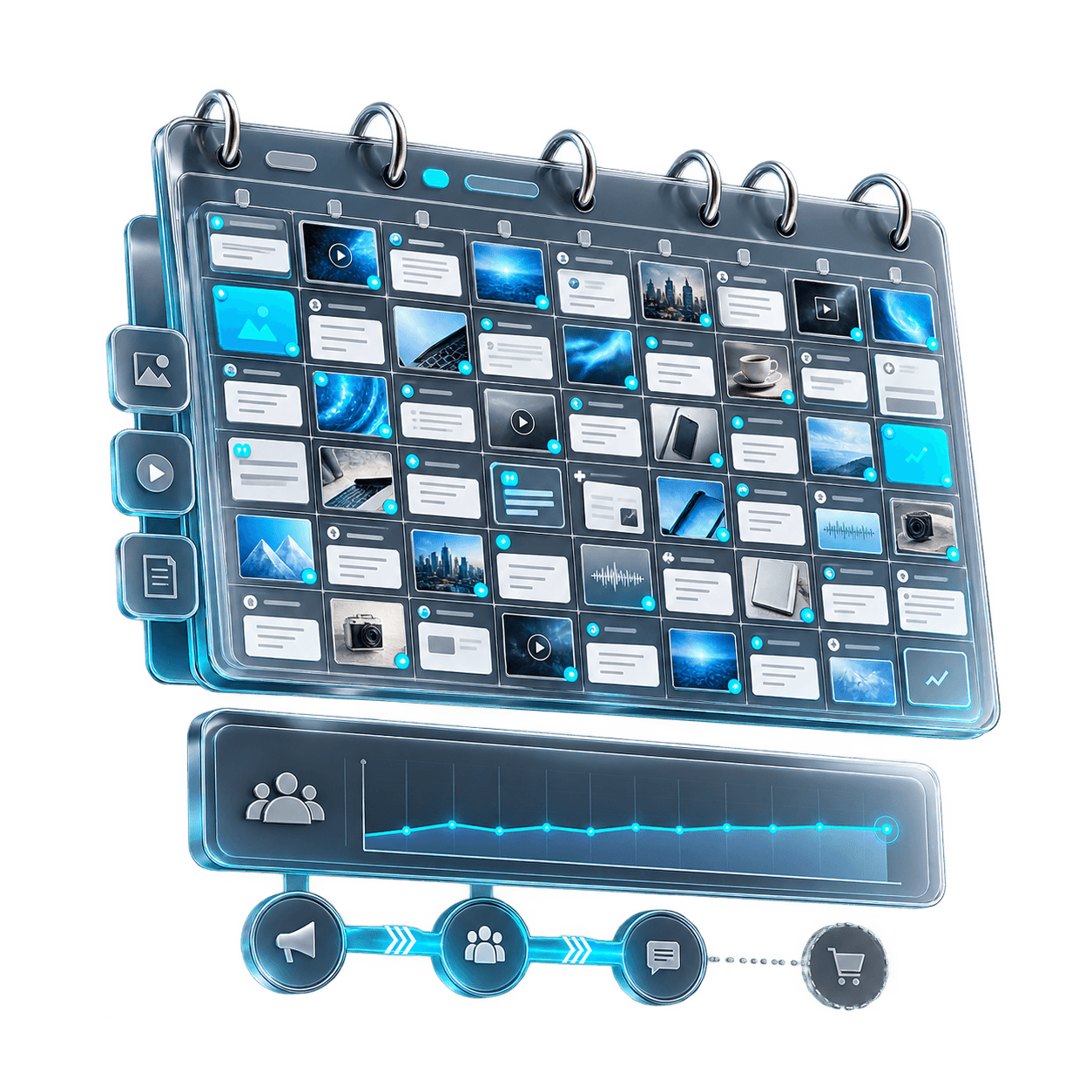
Every touchpoint earns the next.Position → message → action

01 / Why the skepticism is earned

The expensive part was never the deck. It was everything the deck failed to change.

01

The beautiful deck that changed nothing.

Here's the experience that made you skeptical, and you're right to be: a brand agency was hired, a large invoice was paid, and what came back was a beautiful deck. New colours, new tagline, a brand book nobody opened again. Nothing measurable changed. The problem usually was not the design quality. Designers were briefed before strategy existed, concepts were developed before anyone mapped what the buyer actually believes and doubts, and the tagline was workshopped before anyone checked what competitors already said.

02

The full calendar that built no audience.

Content programs fail the same way. The calendar is full: posts, articles, and videos all shipping on schedule. Engagement looks fine, and none of it can be traced to pipeline because nobody defined what a specific piece was supposed to make a buyer think, feel, or do next.

03

The gap between brand and performance.

Underneath both sits a structural gap: the brand people and the performance people work from different briefs toward different scoreboards. Ads run against creative never designed for distribution, and positioning work never reaches the landing pages where conversion happens.

THE ELEVYNX STANDARD

Brand and creative work built strategy first and measured commercially behaves completely differently. That's the only version we do.

02 / The performance variable

Your positioning is a performance variable.

Most agencies will never tell you that, because half do not run ads and the other half do not build brand.

01

Clear positioning lowers your ad costs.

When the right buyer instantly recognises “this is for me” and the wrong buyer recognises it is not, the message filters before the click. Fewer wasted clicks, more qualified landings, and lower cost per lead. We measure the before-and-after because we run the ads after we build the positioning.

02

A documented message shortens your sales cycle.

A documented messaging system gives the team exact language for the differentiation argument, proof points, and objection answers at each stage. Less educating per call means faster qualification and faster closes, measured in the CRM before and after the work ships.

03

Creative quality is a conversion input at every step.

The ad, landing page, follow-up email, and sales deck each either build the sense that the company operates at a high level or quietly undermine it. Every asset is held to one question: does it move this specific person one step closer to buying?

04

Ads stop when the spend stops. Brand compounds.

Ads buy results proportional to spend. Brand authority works differently: useful content, social audience, and reputation keep producing after the invoice and make every future campaign cheaper. We build both.

03 / Our order of operations

Strategy before brief. Buyer before design. Result before done.

  1. 01

    Positioning built from research, not workshops.

    Stakeholder workshops only tell you what the company thinks about itself. We add a structured read of competitor language, repeated category claims, and the space that is both empty and worth owning.

  2. 02

    Every brief starts with buyer psychology.

    Before anything is made, we map what your buyer believes, doubts, wants, and fears. That map decides the message angle, proof, tone, and objections the asset must answer.

  3. 03

    Ad creative goes into the same testing system as the ads.

    Every paid asset enters a structured framework: a hypothesis, success metric, significance bar, and documented result. Over time, you own the tested record of messages and formats that work.

  4. 04

    Social is audience building, not calendar filling.

    We grade social by ideal-buyer fit, the share of pipeline that consumed the work before the first sales call, and whether the brand is being cited and recommended in its category.

  5. 05

    Commercial success metrics are defined before the work starts.

    We agree what number should move: paid conversion for positioning, performance for ad creative, or content-to-pipeline attribution for social. Then we measure it after.

04 / What we build

One message system, expressed wherever buyers meet it.

01

System 01

Positioning

The words and position your whole growth system runs on: what you say, to whom, and why it beats what every competitor says.

  • Positioning strategy and market differentiation
  • Competitive landscape analysis: repeated category claims and the space left open
  • Target audience definition and buyer psychology mapping
  • Messaging system: value propositions, proof points, and objection answers by funnel stage
  • Brand voice and communication rules your team can actually follow
  • Naming and brand structure for new offers or markets

What you getA position that survives competitive comparison, messaging your sales team actually uses, and a clear basis to measure whether better-matched buyers click.

Explore Brand Strategy & Positioning


02

System 02

Creative & Content

Everything your system needs made: ads, video, design, sales materials, and content that brings buyers in organically, produced against strategy, not taste.

  • Visual identity: logo systems, design guidelines, and brand systems
  • Ad creative for every paid channel: static, motion, video, and UGC-style
  • Video production: brand films, product videos, and testimonials
  • Website and landing-page copywriting
  • SEO content and blog systems built around buyer search behaviour
  • Sales materials and email content across every sequence

What you getConsistent, premium output at a fraction of in-house cost, with every paid asset entering the testing framework and every content piece tied to a defined job in the journey.

Explore Creative & Content Production

05 / Built on our own standard

How we built ELEVYNX.

The standard we hold client work to is the one we hold our own to. Every visual decision below is traceable to a strategic choice. Until client brand work is publishable, we show the process on ourselves plainly.

Identity specimen01 / 03
ELEVYNX logo

ObserveName the decision and buyer.

DefineTurn difference into language.

ComposeGive every visual a job.

06 / The revenue conversation

Justify brand investment with arithmetic, not adjectives.

If you're the one who believes in this work but has to convince a CFO, a board, or a skeptical co-founder: use verified inputs. These are illustrative calculations, not forecasts.

01

Paid efficiency

Annual paid spend × conversion-efficiency gain

Illustrative: a 15–25% gain on $500K annual spend equals $75K–$125K protected yearly. Use your verified spend and baseline.

02

Sales velocity

Average deal value × time recovered × selling capacity

Illustrative: cutting a 90-day cycle to 75 days frees roughly 12% of a representative’s capacity before adding headcount.

03

Compounding demand

Qualified organic visits × paid-click equivalent

Illustrative: 20 search terms × 50 qualified visits/month × $30 paid-click equivalent = $360K annual paid value not rebought.

07 / Evidence protocol

Brand work, measured like ad work.

“Beautiful rebrand” is not a result. “Ad conversion up 22% in the 90 days after the positioning rebuild” is. Evidence is published only when a client approves the inputs and attribution.

Evidence slots / verified inputs only
Conversion change[Baseline] → [Post-launch]
Sales-cycle change[Baseline] → [Post-launch]
Creative response[Hypothesis] → [Winner]

Research, then strategy, then creative, then measurement. The process is the product.

09 / Start with the message

Not sure if your message is what's holding growth back? That's exactly what the diagnostic answers.

A brand diagnostic looks at three things honestly: where unclear positioning creates friction in your ads, sales calls, and pages; what space in your category is open that your message is not claiming; and the gap between how you want to be seen and how buyers actually see you. The answers show whether the fix is positioning, creative, social, or a combination, and what the commercial case looks like in your numbers.

Request a Brand Diagnostic Every request reviewed personally. Response within 24 hours.